

You’ve put in the years. The trucks are paid off, the crew shows up, and the phone rings with work. By most measures, you’d say you built a business. But there’s a harder question underneath that one, and most contractors never ask it until they’re forced to: if you had to sell tomorrow, or if your body simply couldn’t do the work anymore, what would actually be worth buying?
For many contractors, the honest answer is uncomfortable. What they built isn’t a business in the way a buyer, a bank, or a partner would define it. It’s a job — a demanding, physical, high-overhead job that happens to have a logo on the truck. And a job isn’t sellable. An asset is.
The Job You Can’t Leave vs. The Business You Could Sell
The difference between these two isn’t revenue. Plenty of one-person operations pull in solid money. The difference is what happens when the owner isn’t the one doing the work.
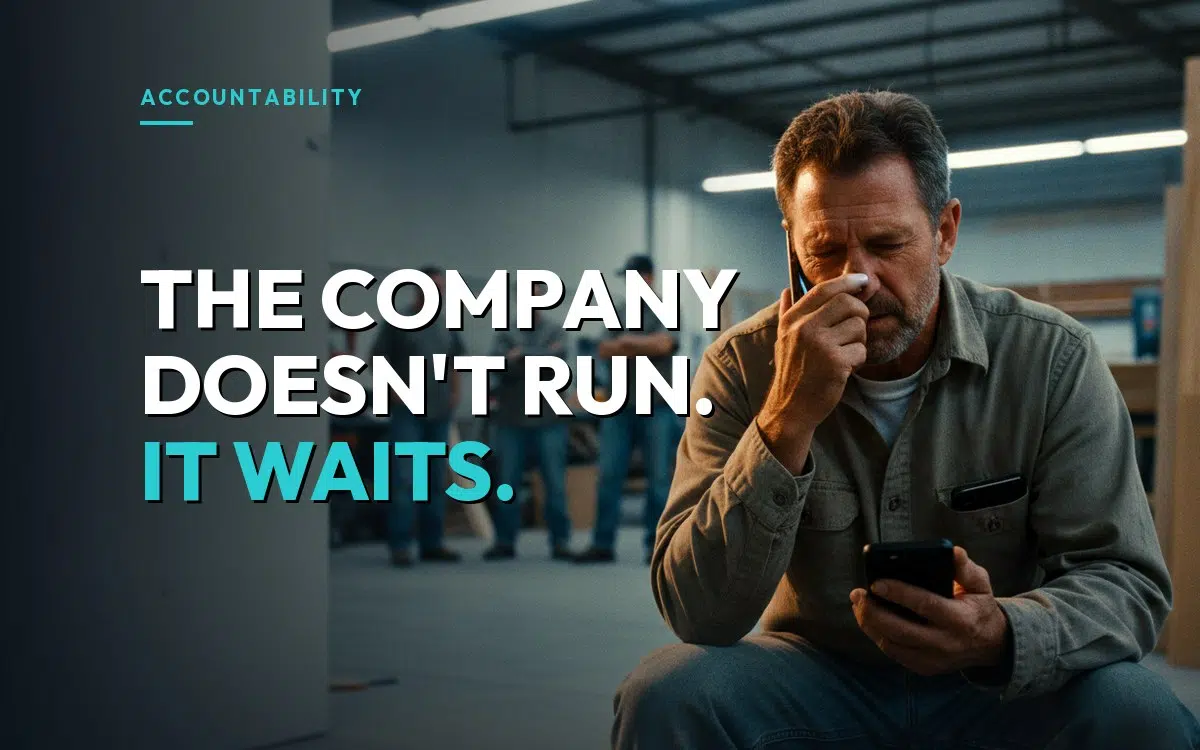
In a job-with-overhead setup, the owner personally manages every customer relationship. The owner prices every job, usually by feel, standing in the driveway. The owner is the one the crew calls when something goes sideways on site. Take that owner out of the picture — vacation, injury, or retirement — and the business doesn’t just slow down. It stops.
In a sellable asset, none of that critical information resides in just one person’s head. Customer relationships are documented and maintained through a system, not a memory. Pricing follows a process that a lead tech or office manager could run without guessing. The team has a structure that functions on a normal week, whether or not the owner is on-site.
Same trade. Same truck. Completely different thing when someone tries to put a value on it.
What Buyers Actually Pay For
When someone evaluates a contracting business for purchase — a private buyer, a competitor looking to expand, even a family member considering taking it over — they’re not pricing the owner’s skill with a wrench or a panel. They’re pricing four things:
- Recurring revenue they can verify. Maintenance plans, repeat customers, contracts — proof the work keeps coming without a personal sales pitch every time.
- A team that runs without the owner. A second-in-command, a foreman, an office manager — someone who can carry a normal week solo.
- Clean books. Financials separated from personal expenses, consistent enough that a stranger could read them and trust the numbers.
- Documented systems. Pricing, scheduling, hiring, and quality control — written down instead of living only in the owner’s habits.
What most contractors actually have to offer instead is equipment and a phone number. Trucks depreciate. Tools sell for scrap value. A phone number doesn’t transfer trust to a new owner. That’s the gap between a business that sells for something and one that gets liquidated at auction — and it shows up directly in how buyers price a contracting business.
Why Most Contractors Never Notice The Gap
Nobody sets out to build a business that only works when they’re personally swinging the hammer. It happens by accident, one reasonable decision at a time. It’s faster to price the job yourself than to train someone else to do it right. It’s easier to take the customer call than to build out a system for someone else to take it. Early on, that’s just how a lean operation survives.
The problem is that “lean and personal” never automatically evolves into “documented and transferable.” It stays exactly the way it started unless someone deliberately changes it. Ten or twenty years can pass with the business getting bigger — more trucks, more revenue, more crew — without ever becoming more sellable. Bigger job. Still a job.
Six Questions That Tell You Which One You Have
You don’t need a formal valuation to get a rough read on where you stand. Ask yourself honestly:
- Does every price quote still run through you personally?
- Do customers call your cell phone, or a business line someone else can answer?
- Could your team run a normal week if you didn’t check in at all? (If not, start here.)
- Are your books clean enough that a stranger could trust them without you explaining every line?
- Is there anyone besides you who could explain how the business actually makes its money?
- If you took a real month off — no calls, no texts — would revenue keep moving?
If most of your answers point back to “only me,” that’s not a failure. It’s just useful information. It means you’re standing on a job, not an asset, and now you know exactly which two or three things need to change first.
Twenty Years From Now, What Does Your Exit Look Like?
Every contractor exits the business eventually — by choice or otherwise. The only real question is what’s waiting on the other side of that exit. Some owners spend twenty years building income and end up with a pile of depreciated equipment and a decision to “sell the trucks and hope.” Others spend the same twenty years building something a buyer would actually want, and they get to choose their own timeline instead of having it chosen for them.
The gap between those two outcomes isn’t talent or luck. It’s whether the business was ever built to run without its owner. That’s a fixable problem — but only if you find out where you stand while there’s still time to fix it.
Take the Next Step
You don’t need to guess where your business falls on the job-versus-asset spectrum. The free Contractor Growth Assessment shows you how close your business is to running — and being worth something — without you.